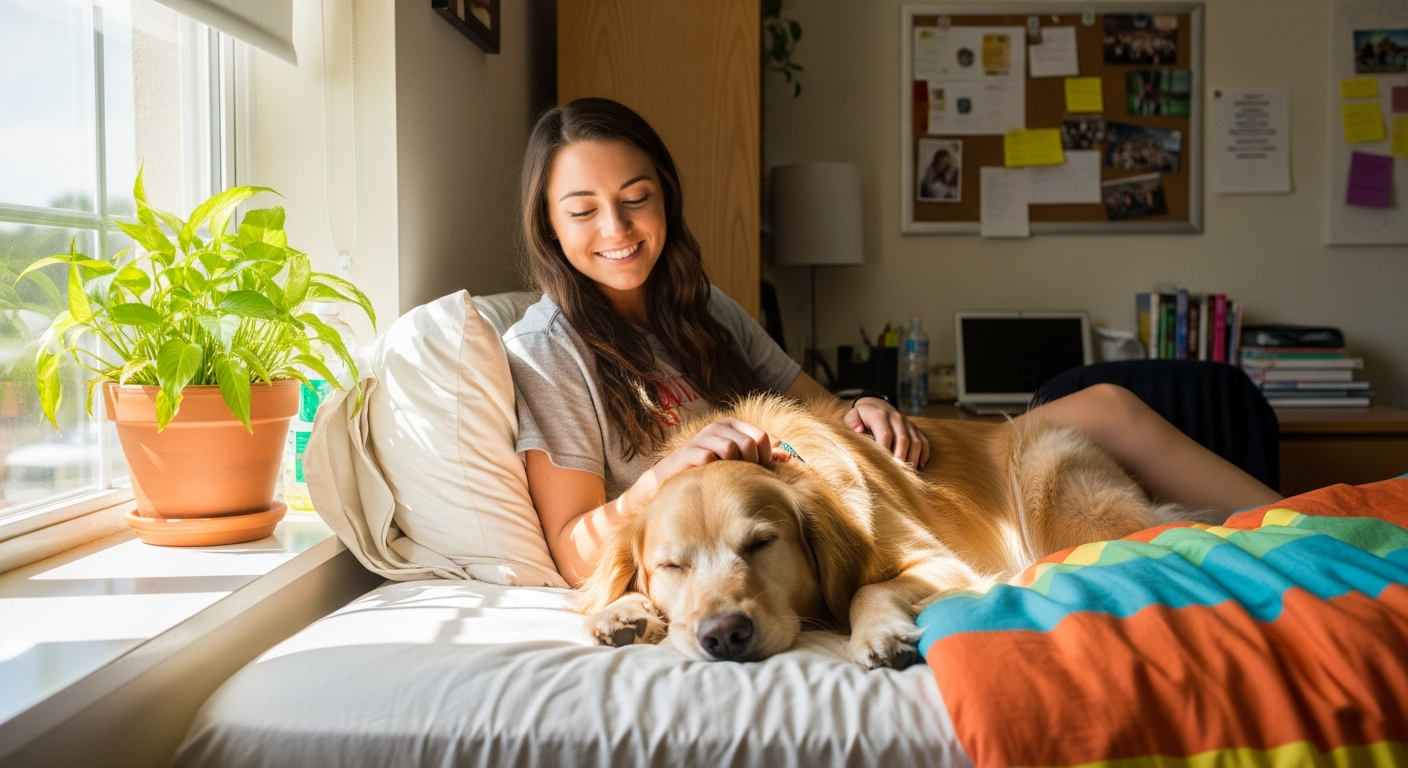
Your Housing Rights Follow You to Campus
Many students assume the protections that apply to apartment renters stop at the edge of campus. They do not. The same federal Fair Housing Act (FHA) that requires landlords to make reasonable accommodations for tenants with disabilities also reaches college and university residence halls, and Florida adds its own layer through Florida Statute 760.27, which governs emotional support animals in dwellings across the state. A dorm room is, in the eyes of these laws, a dwelling. That means a qualified student can request to keep an emotional support animal (ESA) in campus housing as a reasonable accommodation.
There is one important distinction to understand from the start. An ESA is not the same as a service animal. Service animals are trained to perform specific tasks and may accompany a handler almost anywhere on campus, including classrooms and dining halls. An ESA provides comfort through its presence and is generally permitted in housing only. You should not expect to bring an ESA into lecture halls, libraries, labs, or campus eateries.
The other detail that surprises students is where the request goes. On-campus ESA requests are not handled by residence life or your resident assistant. They are routed through each school's disability or accessibility office, which reviews documentation, determines eligibility, and then coordinates the approved accommodation with the housing department. Below is how that works at five of Florida's largest universities. Note that the offices have different names at each school, so use the correct one.
1. University of Central Florida (UCF)
Located in Orlando and one of the largest universities in the country with roughly 70,000 students, UCF handles accessibility through its Student Accessibility Services (SAS) office. Begin at sas.sdes.ucf.edu, where you register with SAS and submit your supporting documentation. Once your request is reviewed, SAS coordinates the approval directly with Housing and Residence Life.
Plan ahead. UCF's review can take up to several weeks, and in some cases up to eight weeks, so apply as early as possible rather than waiting until move-in approaches. One more caution: UCF does not accept "registrations" purchased from national online ESA websites. Your documentation must come from a legitimate licensed mental health professional (LMHP) who knows you, not a certificate mill.
2. University of Florida (UF)
UF, in Gainesville and home to roughly 55,000 students, manages accommodations through its Disability Resource Center (DRC). Start at disability.ufl.edu/housing-accommodations. The process begins when you register with the DRC and submit medical documentation. You will then attend a housing accommodation meeting to review your request. After approval, the DRC forwards the accommodation to Housing and Residence Education, and your ESA is permitted to live with you in the residence halls.
3. Florida International University (FIU)
FIU, in Miami with roughly 56,000 students, routes ESA requests through its Disability Resource Center (DRC). The relevant page is FIU's service animals and ESAs page. You register the ESA with the DRC, working alongside Housing, and you provide a support letter from a licensed health care provider. Approval must be in place before the animal can reside on campus, so do not bring your ESA to your room in anticipation of a decision that has not yet been granted.
4. University of South Florida (USF)
USF, based in Tampa with roughly 50,000 students, handles accommodations through Student Accessibility Services (SAS). Begin at usf.edu/student-affairs/student-accessibility. You apply to SAS with your documentation and then complete an intake meeting, which typically happens within about seven to ten days. Once your eligibility is established, SAS coordinates the housing accommodation with the residential team.
5. Florida State University (FSU)
FSU, in Tallahassee with roughly 44,000 students, manages ESA requests through its Office of Accessibility Services (OAS). The policy lives at FSU's emotional support animal policy page. OAS administers the ESA accommodation policy and the associated housing application, then coordinates the approved accommodation with University Housing so your animal can join you in your residence hall.
How the Process Generally Works
Although the office names and timelines vary, the path is remarkably consistent across all five schools. A few habits will keep your request on track:
- Register with the disability or accessibility office early, well before move-in, since reviews can take anywhere from a week to two months depending on the school.
- Provide documentation from a licensed mental health professional who has a genuine, ongoing relationship with you. Letters from online services that issue a certificate after a quick questionnaire are routinely rejected.
- Wait for written approval before move-in. Bringing an animal to your room before the accommodation is granted can create avoidable conflicts with housing policy.
- Once approved, your ESA lives with you in your residence hall room, your private dwelling on campus, rather than accompanying you across general campus spaces.
Throughout, the framing is the same one that protects tenants off campus: a reasonable accommodation under the FHA and Florida Statute 760.27, supported by documentation from a licensed provider. Keep in mind that university deadlines are tied to the housing calendar, so the safest approach is simply to start before the term begins.
Find out if you qualify for an Florida ESA letter
Answer a few quick questions and talk with an Florida-licensed therapist.
Get My Florida ESA Letter